

ProSaDi Sub-project 2: PAESE 3.0 (Provenance Research)
ProSaDi Sub-project 2: PAESE 3.0 (Provenance Research)
Project team
Prof. Dr. Lynn Rother
Dr. Claudia Andratschke
Prof. Dr. Monika Sester
Prof. Dr. Sascha Koch
Prof. Dr. Thomas Brinkhoff
Prof. Dr. Sebastian Vehlken
Agustina Andreoletti
Anastasia Bauch
Inga Kirschnick
Nnenna Onuoha
Olga Shkedova
Link to the PAESE 3.0 Survey form
PAESE 3.0: Investigating the Gaps, Ethics, and Digital Futures of Colonial Provenance Data
The transdisciplinary subproject PAESE 3.0 critically evaluates the strengths and limitations of the existing data sets of cultural goods from colonial contexts, while using the PAESE database as an example and exploring how these insights can inform more equitable, accessible, and operational data practices. Key areas of focus include data silences and provenance uncertainties; secret, sacred, sensitive, and private materials; collaboration for dignity restoration; shifting geographical markers; harmful language and controlled vocabularies; and the affordances and constraints of digital restitution.
The initial PAESE Project (Provenance Research in Collections from Colonial Contexts in Lower Saxony), which ran from 2018-2022, established an infrastructure for collaborative provenance research in Lower Saxony. It also launched a joint online database—now hosted by the Network for Provenance Research in Lower Saxony—to connect object histories to their colonial contexts. This database currently presents object data and free text in a hybrid form, which reflects a systematic research process that not only uncovers the violent contexts of collections but also contextualizes them within transnational debates on indigenous cultural heritage, cultural property, restitution, and shared heritage.
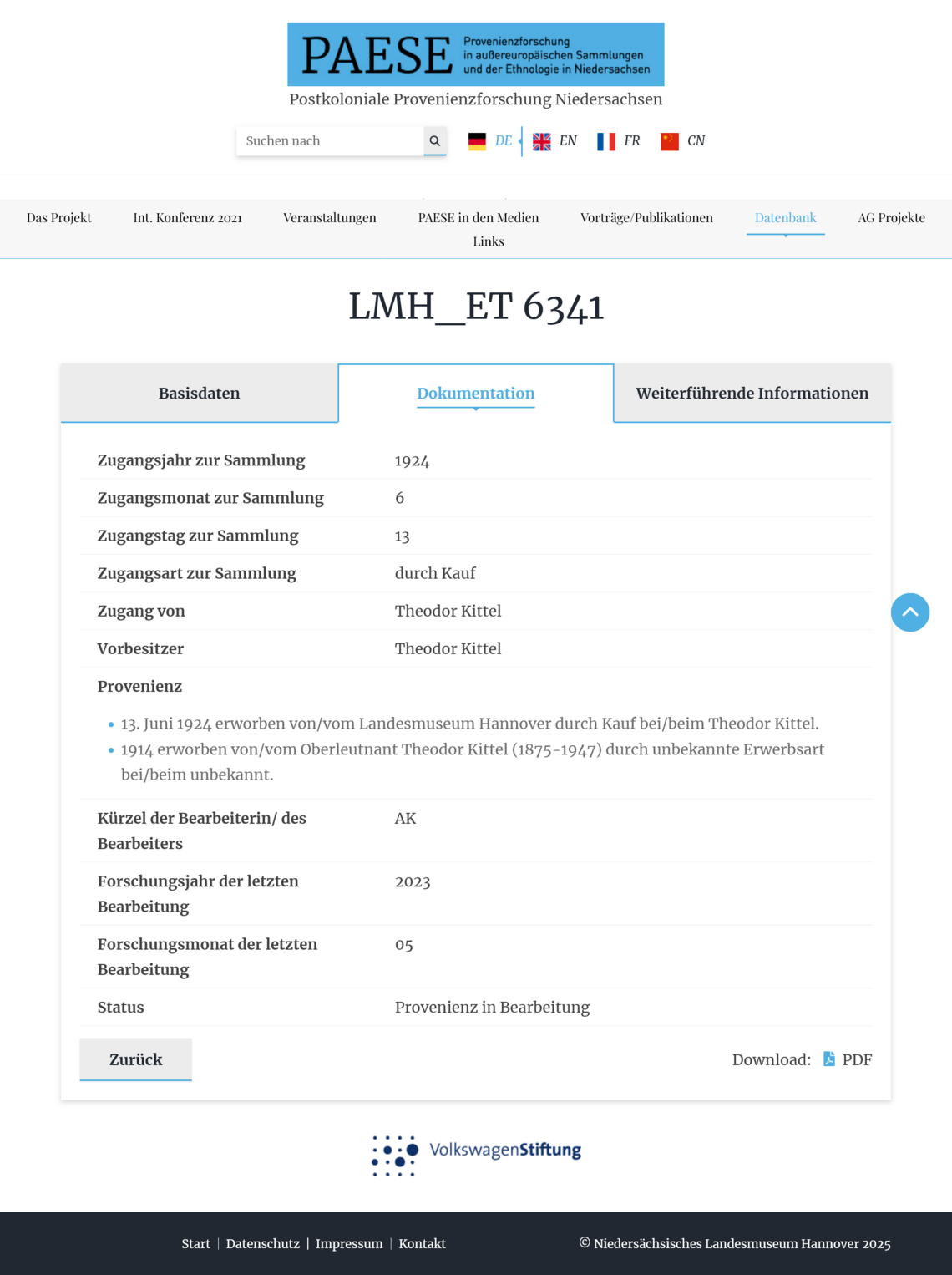
PAESE 3.0 extends this foundation through transdisciplinary collaboration with researchers working across digital humanities, data visualization, large language models, and geographical analysis. As part of the next phase, the PAESE Database will be transitioned into a Linked Open Data structure to make information more transparent, interoperable, and accessible worldwide. Conscious of the broader implications for members of communities from which these objects come, the project poses three key questions: What are the epistemological, ethical, and technical limits of the existing provenance database? How can data governance ensure that communities receive meaningful control over their own cultural heritage data without reproducing the extractive and classificatory logics of colonial collection? And how might provenance databases represent spatial information where colonial and postcolonial processes have continually reshaped place names and territorial boundaries?
The project has started with an international survey of indigenous and non-indigenous community members, digital specialists, and colonial and global historians to assess how digital object biographies and provenance data models can better reflect global historical perspectives and future-oriented ethical research. The results of this survey will be published and will serve as a foundation for building collaborations with community members that create real opportunities for dignity restoration and community-led decision-making.